
Choosing a 3D Skin Scanner in 2026 requires more than comparing screen size, software, or price. Clinics need to know what the device measures, how consistently it measures it, and whether its results help guide a real consultation. Demand for aesthetic services provides useful context. The International Society of Aesthetic Plastic Surgery’s 2023 International Survey reported approximately 34.9 million surgical and nonsurgical aesthetic procedures worldwide, including about 19.1 million nonsurgical procedures. That figure signals a large service environment, but it does not prove that every clinic needs a scanner. Nor does it validate any device’s claims.
Look closely at the details. Ask how the system captures facial contours, skin texture, pigmentation, and pores, and whether lighting and positioning remain controlled between visits. Request evidence on repeatability, staff training, data handling, and compatibility with your consultation workflow. A polished image is not the same as a reliable measurement. Vendors may describe features differently, so compare documented methods rather than marketing labels. Check whether the device’s intended use matches your setting, and avoid treating cosmetic imaging as a substitute for clinical diagnosis.
There is a practical trade-off. A scanner that produces impressive images may still slow appointments or create confusing reports. Ask for a live demonstration using realistic room conditions, then review sample outputs with the people who will use them. The right choice depends on your patients, services, budget, and follow-up process—not on a feature list alone. Some criteria will remain imperfect; that is a reason to ask better questions, not to accept vague answers.
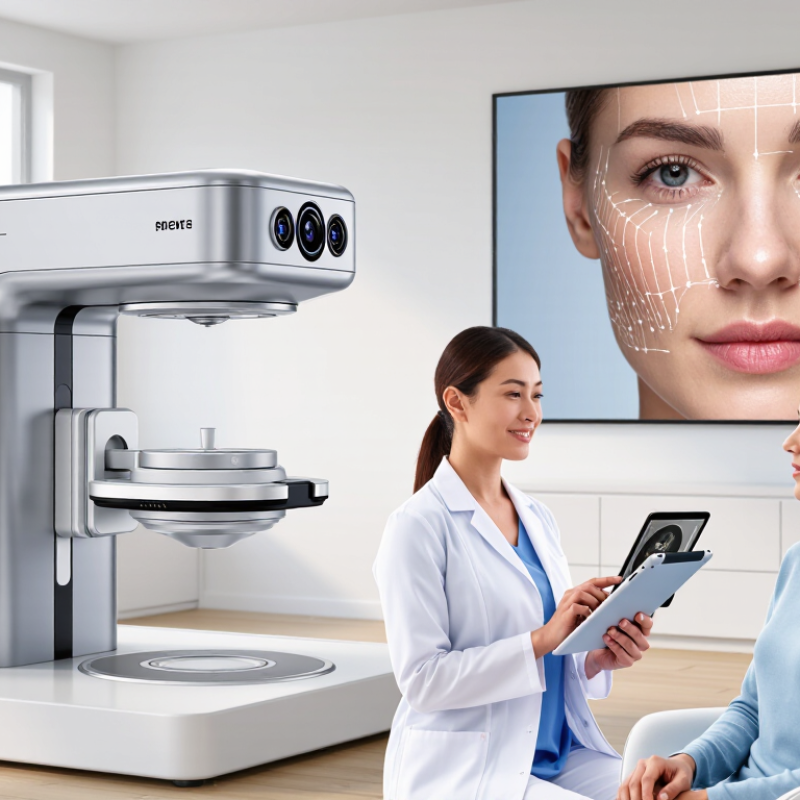
Choose a 3D skin scanner by the decision it must support: tracking texture, mapping pigmentation, assessing pores, or measuring facial shape. One score can blur important differences. Texture needs repeatable close-up detail. Pore assessment depends on consistent magnification and lighting. Pigmentation analysis benefits from controlled illumination and, where appropriate, cross-polarized or multispectral capture. Otherwise, glare may look like a skin change. Geometry is different. Look for calibrated depth capture and repeatable head positioning, not merely a polished 3D image.
The American Society of Plastic Surgeons’ 2023 Procedural Statistics Report counted 25.4 million minimally invasive cosmetic procedures in the United States. That scale makes reliable before-and-after measurement useful, but demand alone does not validate a scanner. The ISIC 2020 challenge dataset contained 33,126 training dermoscopic images for lesion analysis; those data do not establish accuracy for pores or wrinkles. That distinction matters. Ask for repeatability data on the exact measurements you need, including tests across skin tones and operators. Check image consistency, measurement units, capture time, and whether results shift after repositioning. Some systems may still miss subtle changes. It is worth admitting.
A skin scanner’s smooth-looking model can still hide measurement error. ISO 10360-13:2021 provides acceptance and reverification tests for optical 3D coordinate measuring systems. It is a test framework, not one universal pass number. Ask for the scanner’s declared maximum permissible error and the test results supporting it. Check the measurement volume used: performance at the center may differ from performance near the edges.
Look for independent, repeatable measurements using calibrated reference artifacts, not just attractive sample images. NIST’s report, NISTIR 8098, describes six performance tests for 3D imaging systems, including spatial resolution, point-to-point distance, and sphere form. These checks reveal different weaknesses. For a skin scanner, fine surface detail matters, but so does dimensional consistency across the face or body. Ask how results change with working distance, lighting, and repeated scans. Small shifts count.
Then test real capture conditions. Skin moves; hair, shine, and facial expression can disrupt alignment. A scanner may meet a laboratory specification yet struggle with a blinking subject. That gap is worth examining. Request repeat scans of the same area, compare landmark distances, and record the device position and lighting. ISO-based verification strengthens confidence, but it does not replace a practical trial with representative users. Some uncertainty remains, especially around motion.
When choosing a 3D skin scanner in 2026, ask how reliably it measures the same person under controlled conditions. ISO 5725-2:2019 describes methods for assessing repeatability and reproducibility. It is not a scanner-specific certification, so request a clear, documented test protocol.
Repeatability means results stay close when conditions remain nearly identical: the same operator, scanner, room, and short testing interval. For example, scan one volunteer three times, keeping their chin position and facial expression steady. Compare measurements such as cheek volume or wrinkle depth. Small differences matter. A polished 3D image can still hide inconsistent measurements.
Reproducibility tests whether results remain comparable when conditions change, such as the operator, day, device, or location. Ask for results across several operators and sessions, not just repeated scans by one trained specialist. Review the spread of measurements and how it compares with the changes the scanner claims to detect. Also ask whether lighting, skin preparation, and positioning were controlled. Details count. ISO 5725-2 offers a useful framework, but study design and reporting affect what the numbers mean. I would be cautious about a single impressive accuracy figure; it may not reflect everyday clinic conditions. A complete report should identify tested factors, sample size, measurement units, and sources of variation.
When choosing a 3D skin scanner in 2026, check what ISO 20685-1:2018 actually covers. It provides a protocol for evaluating body dimensions derived from 3D scans. It does not automatically verify every facial measurement or prove that a scanner suits your intended use. Ask for the test report, the measured dimensions, and the conditions under which testing took place.
For facial measurements, request evidence for the specific outputs you need, such as interpupillary distance or nose width. Check how the system identifies landmarks and handles head position, facial expression, and repeated scans. A small change in chin angle can shift a measurement. Ask whether results were compared with an appropriate reference method, and review measurement error alongside repeatability. The label alone is not enough.
Try the scanner with people resembling your intended users, under realistic room lighting and workflow conditions. Include repeated scans of the same person, then compare results across operators if staff will take measurements. No scanner is perfect. I would still question a smooth demonstration if the supplier cannot explain its sample size, test setup, or limitations. Record those details before purchase. A clear, bounded claim is more useful than a broad promise of “ISO compliance.”
How to Choose a 3D Skin Scanner in 2026?
A polished scan is not enough. For a scanner intended for medical use, ask how its manufacturer manages design changes, supplier controls, complaints, and corrective actions under ISO 13485:2016. ISO’s 2022 Survey reported 31,795 valid ISO 13485 certificates across 97 countries. That figure reflects certificates, not product performance or safety. Check that the certificate covers the actual manufacturer and relevant activities, rather than assuming any certificate guarantees a reliable device. Paperwork can reassure. It can also mislead.
IEC 60601-1 addresses basic safety and essential performance for medical electrical equipment. Request the test report, not just a logo or declaration, and confirm the tested model matches the scanner you are evaluating. Look for documented checks relevant to its power supply, electrical leakage, and operation under normal and fault conditions. Ask whether the standard’s applicable edition and deviations are identified. For a real-world check, observe a scan in a typical room: cables should stay clear of walkways, and the device should not lose function when repositioned. If the evidence is incomplete, pause and ask why. A small gap in the file may matter.
| Evaluation Dimension | What to Check | Evidence to Request | Why It Matters |
|---|---|---|---|
| Quality Management: ISO 13485:2016 | |||
| Quality management system | Confirm whether the organization responsible for the device operates a quality management system within the scope of ISO 13485:2016. | A current certificate, its stated scope, the certified legal entity, and the certification body’s details. Verify the certificate with the issuer where possible. | ISO 13485 specifies requirements for a medical-device quality management system. A certificate applies to the stated organization and scope; it is not, by itself, proof that a particular scanner is approved or clinically effective. |
| Design and development controls | Ask how intended use, user needs, design inputs, verification, validation, and design changes are controlled. | Relevant design-control summaries, validation plans and reports, change-control procedures, and traceability between requirements and test results. | Documented controls help show that the device was developed and evaluated against defined requirements. |
| Risk management | Review how foreseeable risks are identified, assessed, reduced, and monitored across the device lifecycle. | A risk-management summary covering intended users, use environment, foreseeable misuse, software, and scan-related hazards. | Risk management should inform design decisions, instructions, and post-market monitoring rather than rely on a certificate alone. |
| Production and supplier controls | Check how manufacturing processes, critical suppliers, inspection, and device traceability are controlled. | Quality-process summaries, applicable inspection records, supplier-control information, and device or software version identification. | Consistent production and traceability help support device conformity and investigation of reported issues. |
| Complaints and corrective action | Ask how complaints, nonconformities, corrective actions, and safety-related feedback are handled. | Documented complaint and corrective-action processes, plus information on how users report incidents and receive safety updates. | Post-market feedback can reveal problems that were not apparent during development or initial testing. |
| Electrical Safety and Essential Performance: IEC 60601-1 | |||
| Applicability to the scanner | Determine whether the scanner is medical electrical equipment within the scope of IEC 60601-1, considering its intended use, electrical design, and configuration. | A written applicability rationale and the manufacturer’s list of applicable safety standards for the exact device configuration. | IEC 60601-1 addresses basic safety and essential performance of medical electrical equipment; applicability should not be assumed for every optical imaging system. |
| Basic safety and essential performance | Review the defined essential performance, applicable tests, and outcomes for the scanner and its accessories. | A test report or certification documentation identifying the evaluated model, configuration, standard edition, and test laboratory. | Evidence should relate to the device being purchased, not merely to a similar model or a component. |
| Electrical and mechanical hazards | Check that applicable electrical, temperature, mechanical, and other relevant hazards have been evaluated for the device’s intended environment. | Relevant IEC 60601-1 test documentation and instructions describing installation, operation, cleaning, and maintenance precautions. | Safe operation depends on the complete equipment configuration and the conditions in which it is used. |
| Power supply and accessories | Confirm that the tested configuration includes the supplied power supply, cables, and any accessories required for normal use. | Approved accessory list, equipment labels, and documentation matching the delivered configuration to the safety evaluation. | Changes to power supplies or accessories can affect the safety evaluation; use only configurations specified by the manufacturer. |
| Markings and accompanying documents | Review equipment markings and user documentation for intended use, operating conditions, warnings, and maintenance instructions. | Product labels, instructions for use, installation guidance, and a clear device model and revision identification. | Users need accurate information to install and operate the equipment safely and as intended. |
| Practical Selection Checks | |||
| Intended use and regulatory status | Match the scanner’s stated intended use to the planned setting and use case. Check applicable local regulatory requirements separately. | Intended-use statement, applicable conformity or registration documents, and the exact model identification. | Quality-system certification and electrical-safety evidence do not replace market-specific regulatory authorization or establish clinical performance. |
| Image and measurement validation | Ask what performance has been validated for the intended users, skin areas, lighting conditions, and measurement outputs. | Validation protocols and results, stated limitations, repeatability information, and instructions for standardized image capture. | Performance claims should be supported by evidence relevant to the specific intended use; do not infer clinical accuracy from resolution alone. |
| Software, data, and cybersecurity | Review software version control, update procedures, access controls, data handling, and the manufacturer’s vulnerability-reporting process. | Software lifecycle and cybersecurity documentation, privacy information, update policy, and supported operating-system details. | Connected features and software changes can affect device operation, data protection, and ongoing support. |
| Maintenance and service life | Check calibration or performance-check requirements, cleaning instructions, service availability, and expected support period. | Maintenance schedule, service documentation, cleaning compatibility information, warranty terms, and spare-parts policy. | Clear maintenance and support arrangements help keep the scanner usable and operating as specified. |